What Is A Word Ladder?
Word ladders join two words through a chain of real words, changing one letter at a time. Every step must be a real word of the same length, and you may not add, remove or rearrange letters. The words in between are called rungs, because the finished puzzle is usually written as a column, like a ladder.
For example, COLD becomes WARM in four steps: COLD, CORD, CARD, WARD, WARM. Each word differs from the one before it in exactly one position: L becomes R, O becomes A, C becomes W and D becomes M.
The puzzle is usually credited to Lewis Carroll, who published it as Doublets in 1879. You can read the full story in who invented word ladders.
How Do Word Ladders Work?
Every word ladder follows the same four rules:
- One letter at a time. Each rung changes exactly one letter of the word above it.
- Same length. Every word has the same number of letters as the start word.
- Real words only. Every rung must be a genuine word. Most puzzle setters avoid names, abbreviations and slang.
- No repeats. A word may not appear twice in the same ladder.
Some ladders simply ask you to get from one word to the other in as few steps as you can. Most printed puzzles, including the ones on this site, tell you how many words are missing, and many give you a clue for each one. A clue turns the ladder from trial and error into a chain of small, satisfying guesses.
How Do You Solve A Word Ladder, Step By Step?
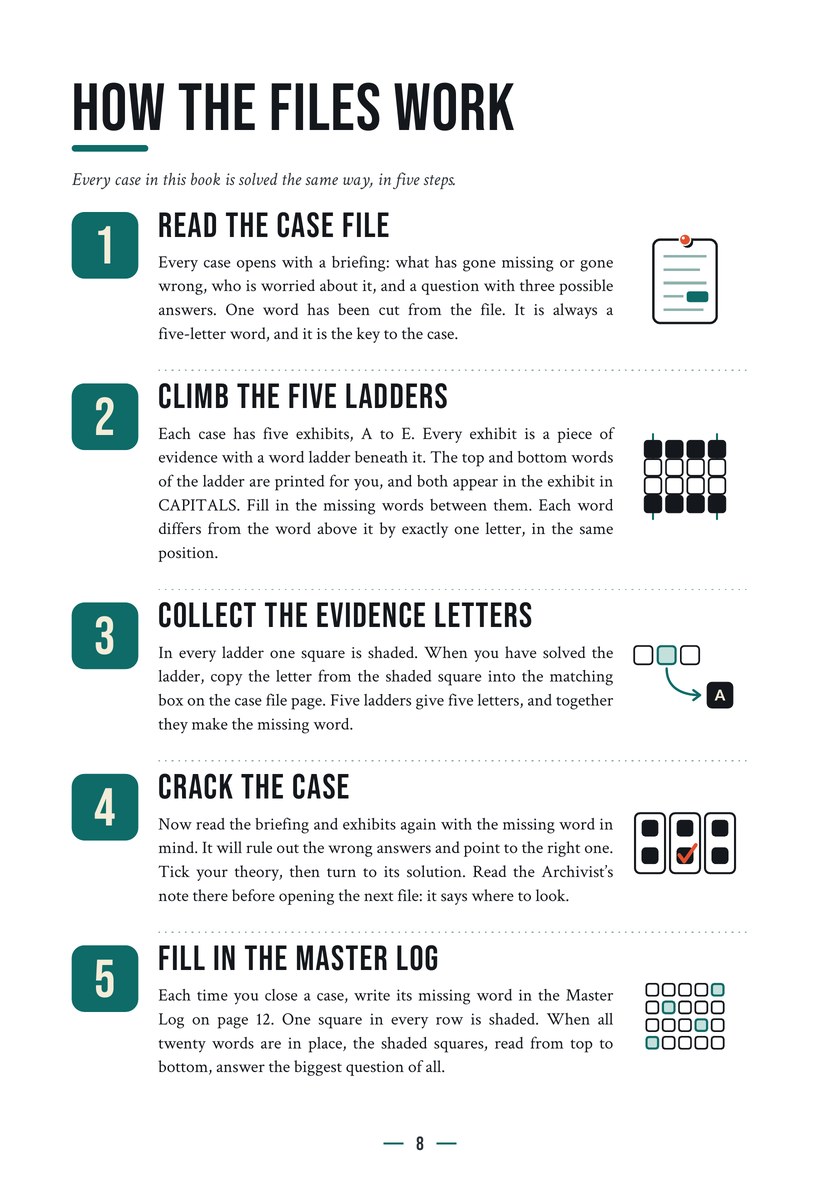
This five-step method works for any word ladder, with or without clues.
- Compare The Two Words. Write the start word above the finish word and mark every letter that differs. Those are the letters you have to change.
- Count The Steps. If the ladder gives a number of steps, compare it with the number of letters that differ. If they match, every step must fix one letter for good. If there are more steps, at least one letter has to take a detour.
- Change One Letter. Change just one letter to make a real word of the same length, ideally a letter that already matches the finish word. Use the clue if there is one.
- Work From Both Ends. If you cannot find the next rung, climb up from the finish word instead, changing one letter at a time, and meet in the middle.
- Check Every Rung. Read the ladder from top to bottom. Each word must be real, differ from the one above it by exactly one letter, and appear only once.
A Worked Example: GAVE To LINK
Here is a ladder with three missing words: change GAVE into LINK in four steps.
Step 1: compare. GAVE and LINK differ in all four positions: G becomes L, A becomes I, V becomes N and E becomes K.
Step 2: count. Four letters must change and there are four steps, so every step fixes one letter for good. There is no room for a detour.
Step 3: change one letter. Try each change in turn. LAVE is not an everyday word, GANE and GAVK are not words at all, but changing A to I gives GIVE. That is the first rung.
Step 4: keep going. From GIVE, changing G to L gives LIVE. From LIVE, changing V to N gives LINE. From LINE, changing E to K gives LINK, the finish word.
Step 5: check. GAVE, GIVE, LIVE, LINE, LINK. Every word is real, each differs from the last by one letter, and none repeats. Solved.
Notice that the order mattered. Only one of the four letters could change first and still make a common word. Spotting which letter can move is most of the skill.
What Are The Best Word Ladder Tips?
These ten tips cover nearly every situation you will meet in a word ladder.
1. Fix The Letters That Already Match
Any letter that is the same in the start and finish words can usually stay where it is. In COLD to CORD to CARD, the D never moves until the very last step.
2. Use The Vowels As Pivots
Swapping a vowel often opens up a new family of words. CAT, COT and CUT share their consonants, so a vowel change is a quick way to reach a word whose consonants you can then change.
3. Work Backwards
The last rung must differ from the finish word by one letter. List the words one letter from the finish word, and you will often see which one links back to your last rung.
4. Meet In The Middle
On longer ladders, solve two or three rungs from the top and two or three from the bottom, then look for the word that joins them.
5. Count Before You Climb
If a ladder has more steps than differing letters, at least one letter must change and later change again. Knowing that in advance stops you hunting for a direct route that does not exist.
6. Read The Clue For The Word Type
Is the clue asking for a noun, a verb or a past tense? A clue like ‘sketched, yesterday’ points to a past tense, which narrows the field at once.
7. Think In Common Endings
English is full of word families such as -ALL, -ILL, -AKE, -INE and -OST. If you are stuck on the first letter, run through the alphabet against a familiar ending: BALL, CALL, FALL, HALL, TALL, WALL.
8. Watch For Dead Ends
Some words have very few neighbours. If a rung leaves you with nowhere to go, step back one rung and try a different letter.
9. Write Options In The Margin
Jot down two or three candidates for a stubborn rung rather than holding them in your head. Seeing them side by side often shows which one leads on.
10. Use A Pencil
A wrong turn rubs out. Experienced solvers expect to backtrack, and a pencil makes that painless.
How Do Word Ladder Hints And Clues Help?
A word ladder with clues gives you a short definition for each missing rung, so you are solving two puzzles at once: the meaning and the one-letter change. When the two agree, you know you are right.
Good word ladder hints come in stages, so you take only as much help as you need:
- A nudge: which position changes on the next rung, for example ‘the second letter changes’.
- A push: the new letter, for example ‘it becomes an I’.
- The rung itself: the whole word, if you really are stuck.
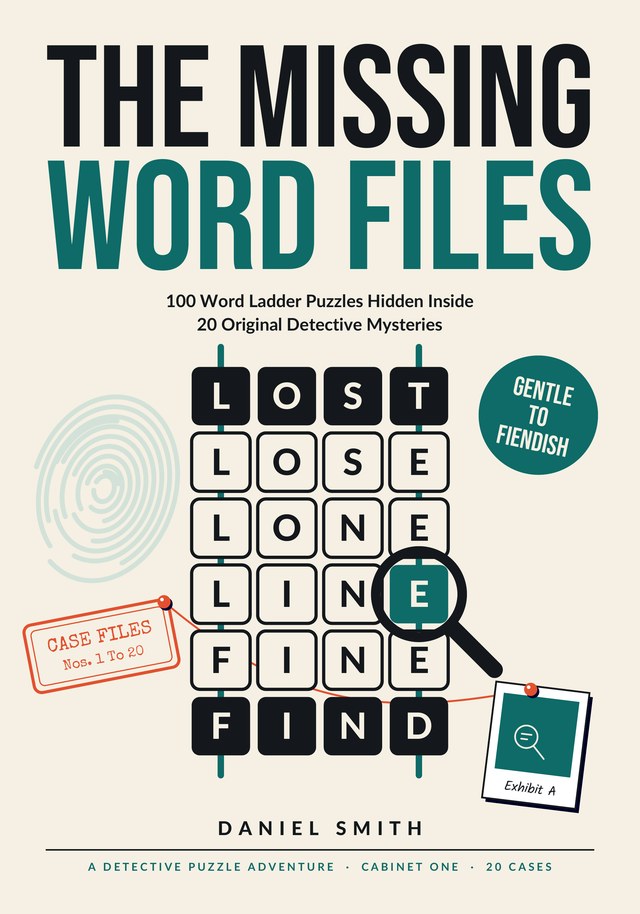
The playable training ladder on the home page works this way: its Hint button tells you which letter to change and what it becomes. In The Missing Word Files, every case has three hints, from a gentle nudge to a firm push, and the solutions at the back explain the reasoning as well as the words.
What Are Word Ladders Good For?
Word ladders are a quiet, screen-free puzzle that needs nothing but a pencil. They make you look closely at spelling, call up words you know but rarely use, and reward patience over speed. Many people enjoy them alongside crosswords and other word games as a short daily puzzle.
Because they need no general knowledge, they suit solvers of any age or background (see our tips on word puzzles for seniors), and they are easy to pitch at different levels: short four-letter ladders with clues for a gentle start, longer five-letter ladders without clues for a real challenge.
Where Can You Practise Word Ladders For Free?
Word Ladder Questions, Answered
What Is A Word Ladder In Simple Terms?
A word ladder is a word puzzle that joins two words by changing one letter at a time. Every step must be a real word of the same length, and you may not add, remove or rearrange letters. For example, COLD becomes WARM in four steps: COLD, CORD, CARD, WARD, WARM.
Can You Add Or Remove Letters In A Word Ladder?
No. In a standard word ladder every word has the same number of letters, so you may only swap one letter for another. Adding, removing or rearranging letters belongs to other word games.
How Many Steps Should A Word Ladder Take?
At least as many steps as there are letters that differ between the start and finish words. COLD and WARM differ in all four letters, so they need at least four steps. Many ladders need more, because a letter sometimes has to change twice.
What If I Find A Different Route?
If every rung is a real word one letter from the last and you reach the finish in the stated number of steps, your route is valid. Where a puzzle gives clues, the clues tell you which of several routes the setter intended.
Who Invented The Word Ladder?
The word ladder is credited to Lewis Carroll, the author of Alice’s Adventures in Wonderland. He said he devised it at Christmas 1877 and published it in Vanity Fair in 1879 under the name Doublets. Read the full history.
Are Word Ladders Hard?
They range from very gentle to genuinely tough. Short four-letter ladders with a clue for every rung suit a beginner. Long five-letter ladders with no clues, where a letter must change twice, can stump an experienced solver.